
This Economics Tutorial will focus on the Theory of Demand. At the end of the tutorial, you can download it for FREE. Please share this page with your friends who may need it.

Imagine you like video games. The theory of demand helps us understand how much you, and others like you, would be willing to buy video games at different prices.
Generally, as the price of video games goes down, the quantity demanded (how many games people want to buy) goes up. On the other hand, if the price goes up, people might not want to buy as many.
This tutorial will try to explain everything you need to know about the Theory of Demand.
At the end of the tutorial, we expect that you should be able to:
(i) Identify the factors determining demand;
(ii) interpret demand curves from demand schedules;
(iii) differentiate between changes in quantity demanded and change in demand;
(iv) compare the various types of demand and their interrelationships;
(v) relate the determinants to the nature of elasticity;
(vi) compute elasticities;
Yeah, that’s a lot so no time to waste!
Page Contents
- Meaning and Determinants of Demand
- Demand Schedules and Curves
- Difference Between the Change in Quantity Demanded and Change in Demand
- Types of Demand
- Types, Nature, and Determinants of Elasticity
- 1. Price Elasticity of Demand:
- 2. Income Elasticity of Demand:
- 3. Cross Elasticity of Demand:
- Practice Questions
- Answers to Practice Questions
- Download this Economics Tutorial for Free
- Recommended Articles for JAMBites
Meaning and Determinants of Demand
The Theory of Demand is a fundamental concept in economics that describes how consumers’ purchasing behavior is influenced by various factors.
It is based on the law of demand, which states that all else being equal, as the price of a good or service decreases, the quantity demanded for that good or service increases, and vice versa.
The demand for a good or service is influenced by several factors, known as determinants of demand. These determinants help explain why and how the quantity demanded for a product changes.
The main determinants of demand include:
- Price of the Good or Service (Own Price): The most basic determinant is the price of the product itself. As mentioned in the Law of Demand, there is an inverse relationship between the price of a good and the quantity demanded.
- Income: Consumer income is a significant factor influencing demand. For normal goods, an increase in income leads to an increase in demand, while for inferior goods, the relationship is inverse.
- Prices of Related Goods:
- Substitute Goods: If the price of a substitute good increases, the demand for the original good may increase.
- Complementary Goods: If the price of a complementary good decreases, the demand for the original good may increase.
- Tastes and Preferences: Changes in consumer preferences or tastes can significantly impact demand. Marketing, advertising, and shifts in cultural trends can influence what consumers prefer.
- Expectations: Consumer expectations about future changes in price, income, or other relevant factors can affect their current demand. For instance, if consumers expect the price of a good to rise in the future, they may increase their current demand.
- Population and Demographics: The size and composition of the population can affect overall demand. Changes in demographics, such as age distribution or population growth, may lead to shifts in demand for certain goods.
- Consumer Confidence: The overall confidence consumers have in the economy can influence their spending habits. High consumer confidence often leads to increased spending and demand.
- Government Policies: Policies such as taxes, subsidies, and regulations can impact the cost of goods and services, affecting demand. For example, a subsidy on a product might increase demand, while a tax might decrease it.
THINK & ACT : If we can give you this for FREE, imagine what we can give if you pay and join the ALLSCHOOL JAMB Online Lesson. In the lesson, our hardworking tutors ensure they only teach you things that will come out in JAMB, so you’ll score extremely high in JAMB. Click Here to join the ALLSCHOOL JAMB Online Lesson NOW.
Demand Schedules and Curves
The demand schedule and curve are tools used in economics to illustrate the relationship between the price of a good or service and the quantity demanded by consumers.
Demand Schedule
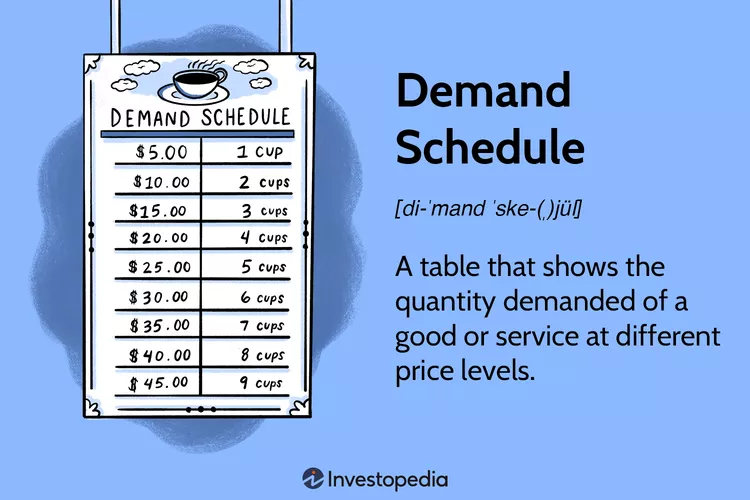
- A demand schedule is a table that shows the relationship between the price of a good and the quantity demanded by consumers at different price levels.
- It typically lists prices in one column and the corresponding quantities demanded in another column.
- The demand schedule can be used to create a demand curve.
Demand Curve

- A demand curve is a graphical representation of the relationship between the price of a good and the quantity demanded by consumers.
- In a typical demand curve:
- The vertical (y) axis represents the price of the good.
- The horizontal (x) axis represents the quantity demanded.
- The curve slopes downward from left to right, illustrating the law of demand—higher prices correspond to lower quantities demanded, and lower prices correspond to higher quantities demanded.
- The shape of the demand curve reflects the inverse relationship between price and quantity demanded.
Shifts in the Demand Curve:
- Changes in factors other than price that influence demand can cause the entire demand curve to shift.
- An increase in demand shifts the curve to the right, indicating that consumers are willing to buy more at each price level.
- A decrease in demand shifts the curve to the left, indicating that consumers are willing to buy less at each price level.
Difference Between the Change in Quantity Demanded and Change in Demand
- Change in Quantity Demanded:
- This refers to a movement along the existing demand curve in response to a change in the price of the good or service.
- It is caused solely by a change in the price of the product, assuming all other factors remain constant (ceteris paribus).
- An increase in price leads to a decrease in quantity demanded, and a decrease in price leads to an increase in quantity demanded, following the law of demand.
- Change in Demand:
- This refers to a shift of the entire demand curve to the right or left.
- It occurs when one or more of the determinants of demand (factors other than price) change. These determinants include income, prices of related goods, consumer preferences, population, and expectations.
- An increase in demand means that consumers are willing to buy more at every price level, and it is represented by a rightward shift of the demand curve.
- A decrease in demand means that consumers are willing to buy less at every price level, and it is represented by a leftward shift of the demand curve.
In summary, the key distinction lies in the cause of the observed changes:
- Change in Quantity Demanded: Movement along the existing demand curve due to a change in price, with all other factors held constant.
- Change in Demand: Shift of the entire demand curve due to a change in one or more determinants of demand, while price remains constant.
THINK & ACT : If we can give you this for FREE, imagine what we can give if you pay and join the ALLSCHOOL JAMB Online Lesson. In the lesson, our hardworking tutors ensure they only teach you things that will come out in JAMB, so you’ll score extremely high in JAMB. Click Here to join the ALLSCHOOL JAMB Online Lesson NOW.
Types of Demand
There are several kinds of demands but for the sake of the JAMB Exam, we are going to explore four types of demands. They include composite demand, derived demand, competitive demand, and joint demand.
Let’s explain all of them!
- Composite Demand:
- Definition: Composite demand refers to a situation where a good or service has multiple uses, and the demand for it arises from various purposes.
- Example: Electricity is a classic example of composite demand. It can be used for lighting, heating, running appliances, and various other purposes. An increase in demand for electricity for one purpose, like heating in winter, can impact the overall demand for electricity.
- Derived Demand:
- Definition: Derived demand occurs when the demand for one good or service is based on the demand for another related good or service.
- Example: The demand for steel in the construction industry is derived from the demand for new buildings and infrastructure. If the demand for new construction projects increases, the demand for steel, a key construction material, also increases.
- Competitive Demand:
- Definition: Competitive demand happens when two or more goods or services can be used to satisfy the same want or need, and an increase in the demand for one product decreases the demand for the other.
- Example: Coffee and tea are often considered competitive goods because they serve a similar purpose as hot beverages. If the demand for coffee increases, it might lead to a decrease in the demand for tea.
- Joint Demand:
- Definition: Joint demand occurs when two or more goods are demanded together because they are complementary or used together to satisfy a particular need.
- Example: Consider the demand for cars and gasoline. These goods are in joint demand because they are typically used together. An increase in the demand for cars will likely lead to an increase in the demand for gasoline to fuel those cars.
Types, Nature, and Determinants of Elasticity
Elasticity is a measure of how responsive the quantity demanded or supplied of a good is to changes in its price, income, or the price of related goods.
There are different types of elasticity, each providing insights into the sensitivity of demand or supply to various factors.
Here’s an overview of price elasticity of demand, income elasticity of demand, and cross elasticity of demand:
1. Price Elasticity of Demand:
Definition: Price elasticity of demand measures the percentage change in quantity demanded in response to a one percent change in price.
Types:
- Elastic Demand (Ed > 1): If the percentage change in quantity demanded is greater than the percentage change in price, demand is considered elastic. Consumers are relatively responsive to price changes.
- Inelastic Demand (Ed < 1): If the percentage change in quantity demanded is less than the percentage change in price, demand is considered inelastic. Consumers are relatively unresponsive to price changes.
- Unitary Elasticity (Ed = 1): If the percentage change in quantity demanded is equal to the percentage change in price, demand is considered unitary elastic.
Nature and Determinants:
- Elasticity varies across different goods and depends on factors such as the availability of substitutes, necessity vs. luxury, and the proportion of income spent on the good.
- Luxuries often have more elastic demand than necessities.
- The availability of substitutes affects elasticity; goods with close substitutes tend to have more elastic demand.
Measurement:
- The formula for price elasticity of demand is:
Ed = % change in quantity demanded (%ΔQ) / % change in price (%ΔP)
Simplified, Ed = %ΔQ / %ΔP
Exercise 1: Suppose the price of a product decreases from N1,000 to N800, resulting in an increase in the quantity demanded from 100 units to 120 units. Calculate the price elasticity of demand.
Solution:
P1 = N1,000
P2 = N800
Q1 = 100
Q2 = 120
Percentage change in price (%ΔP):
%ΔP = { [P2 – P1] / [(P1 + P2) / 2] } x 100
%ΔP = { [800 – 1000] / [(1000 + 800) / 2] } x 100
= – 22.22%
Percentage change in quantity demanded (%ΔQ):
%ΔQ = { [Q2 – Q1] / [(Q1 + Q2) / 2] } x 100
= { [120 – 100] / [(100 + 120) / 2] } x 100
= 20%
THINK & ACT : If we can give you this for FREE, imagine what we can give if you pay and join the ALLSCHOOL JAMB Online Lesson. In the lesson, our hardworking tutors ensure they only teach you things that will come out in JAMB, so you’ll score extremely high in JAMB. Click Here to join the ALLSCHOOL JAMB Online Lesson NOW.
2. Income Elasticity of Demand:
Definition: Income elasticity of demand measures the percentage change in quantity demanded in response to a one percent change in income.
Types:
- Normal Goods (Ey > 0): If the percentage change in quantity demanded is positive, it’s a normal good. An increase in income leads to an increase in demand.
- Inferior Goods (Ey < 0): If the percentage change in quantity demanded is negative, it’s an inferior good. An increase in income leads to a decrease in demand.
Nature and Determinants:
- The nature of the good (normal or inferior) influences income elasticity.
- Luxuries tend to have a higher income elasticity than necessities.
Measurement:
The formula for income elasticity of demand is:
Ey = % change in quantity demanded / % change in income
Simplified, Ey = %ΔI I %ΔQ
Exercise 2: Suppose the quantity demanded of a luxury car increases from 200 to 240 units when consumers’ income rises from N50,000 to N60,000. Calculate the income elasticity of demand.
Solution:
I1 = N50,000
I2 = N60,000
Q1=200
Q2=240
Percentage change in price (%ΔI):
%ΔI = { [I2 – I1] / [(I1 + I2) / 2] } x 100
%ΔI = { [60000 – 50000] / [(50000 + 60000) / 2] } x 100
= 20%
Percentage change in quantity demanded (%ΔQ):
%ΔQ = { [Q2 – Q1] / [(Q1 + Q2) / 2] } x 100
= { [240 – 200] / [(200 + 240) / 2] } x 100
= 20%
Therefore, Ey = 20% I 20% = 1
So, the income elasticity of demand (Ey) is 1.
3. Cross Elasticity of Demand:
Definition: Cross elasticity of demand measures the percentage change in quantity demanded of one good in response to a one percent change in the price of another good.
Types:
- Substitute Goods (Ec > 0): If the percentage change in quantity demanded is positive, the goods are substitutes. An increase in the price of one leads to an increase in demand for the other.
- Complementary Goods (Ec < 0): If the percentage change in quantity demanded is negative, the goods are complements. An increase in the price of one leads to a decrease in demand for the other.
Nature and Determinants:
- The relationship between goods, whether substitutes or complements, influences cross elasticity.
- The availability of substitutes or complements affects cross elasticity.
Measurement:
The formula for cross elasticity of demand is:
Ec = % change in quantity demanded of good X / % change in price of good Y
Simplified, Ec = %ΔQ / %ΔP
Exercise 3: Suppose the price of coffee increases from $3 to $4, leading to a decrease in the quantity demanded of tea from 150 to 120 units. Calculate the cross elasticity of demand between coffee and tea.
Solution:
P1 = $3
P2 = $4
Q1 = 150
Q2 = 120
Percentage change in price of coffee (%ΔP):
%ΔP = { [P2 – P1] / [(P1 + P2) / 2] } x 100
%ΔP = { [4 – 3] / [(3 + 4) / 2] } x 100
= 14.3%
Percentage change in quantity demanded of tea (%ΔQ):
%ΔQ = { [Q2 – Q1] / [(Q1 + Q2) / 2] } x 100
= { [120 – 150] / [(150 + 120) / 2] } x 100
= – 16.67%
But, Ec = %ΔQ / %ΔP
-16.67% / 14.3
= 1.17
And this brings us to the end of this tutorial.
Now, attempt these practice questions.
THINK & ACT : If we can give you this for FREE, imagine what we can give if you pay and join the ALLSCHOOL JAMB Online Lesson. In the lesson, our hardworking tutors ensure they only teach you things that will come out in JAMB, so you’ll score extremely high in JAMB. Click Here to join the ALLSCHOOL JAMB Online Lesson NOW.
Practice Questions
- According to the Law of Demand, what is the expected relationship between the price of a good and the quantity demanded?
A. Direct
B. Inverse
C. Irrelevant
D. Fluctuating - What does the Theory of Demand assume to be constant when analyzing the relationship between price and quantity demanded?
A. Price
B. Quantity demanded
C. Determinants other than price
D. Time - If the price of a substitute good increases, what is likely to happen to the demand for the original good?
A. Increase
B. Decrease
C. Remain unchanged
D. It depends on the type of goods. - What is the effect of an increase in consumer income on the demand for normal goods?
A. Increase
B. Decrease
C. No effect
D. It depends on the elasticity of the good. - A change in the price of a good leads to a change in:
A. Quantity supplied
B. Change in demand
C. Change in quantity demanded
D. Change in supply
- If the demand for smartphones increases due to advancements in technology, what type of change is this?
A. Change in quantity demanded
B. Change in demand
C. Both
D. Neither - When two goods are demanded together because they are complementary, it is known as:
A. Composite demand
B. Derived demand
C. Competitive demand
D. Joint demand - If an increase in the demand for one good leads to a decrease in the demand for another, what type of demand is this?
A. Composite demand
B. Derived demand
C. Competitive demand
D. Joint demand - If the price elasticity of demand for a good is -0.5, what can you infer about the nature of the good?
A. Normal good
B. Inferior good
C. Luxury good
D. Inelastic good - If the cross elasticity of demand between two goods is positive, what can you conclude about their relationship?
A. They are substitutes
B. They are complements
C. They are normal goods
D. They are inferior goods - In the price elasticity of demand formula, what does the percentage change in quantity demanded represent?
A. Change in quantity demanded
B. Initial quantity demanded
C. Final quantity demanded
D. Average quantity demanded - If the income elasticity of demand for a good is 2.5, how is the good classified?
A. Normal good
B. Inferior good
C. Luxury good
D. Inelastic good - What is the primary focus of the Theory of Demand?
A. Supply
B. Consumer behavior
C. Market structure
D. Government regulations - Which determinant of demand refers to the tastes and preferences of consumers?
A. Price of the good
B. Income
C. Prices of related goods
D. Consumer expectations - In the context of elasticity, what does it mean if the absolute value of the elasticity coefficient is greater than 1?
A. The good is inelastic
B. The good is elastic
C. The good is a luxury
D. The good is a necessity
THINK & ACT : If we can give you this for FREE, imagine what we can give if you pay and join the ALLSCHOOL JAMB Online Lesson. In the lesson, our hardworking tutors ensure they only teach you things that will come out in JAMB, so you’ll score extremely high in JAMB. Click Here to join the ALLSCHOOL JAMB Online Lesson NOW.
Answers to Practice Questions
NB: Before checking the answers, make sure you attempt the questions yourself. This will help you understand the topic very well.
- Answer: B. Inverse
- Explanation: According to the Law of Demand, there is an inverse (or negative) relationship between the price of a good and the quantity demanded. As the price decreases, the quantity demanded increases, and vice versa.
- Answer: C. Determinants other than price
- Explanation: The Theory of Demand assumes that factors other than price, such as income, preferences, and the prices of related goods, remain constant when analyzing the relationship between price and quantity demanded.
- Answer: B. Decrease
- Explanation: If the price of a substitute good increases, consumers are likely to shift their demand to the original good, leading to a decrease in the demand for the original good.
- Answer: A. Increase
- Explanation: An increase in consumer income generally leads to an increase in the demand for normal goods. Consumers have more purchasing power, and they are willing to buy more of these goods.
- Answer: C. Change in quantity demanded
- Explanation: A change in the price of a good leads to a movement along the existing demand curve, resulting in a change in the quantity demanded.
- Answer: B. Change in demand
- Explanation: An increase in the demand for smartphones due to technological advancements represents a change in demand. It could be influenced by factors other than price, such as changes in consumer preferences.
- Answer: D. Joint demand
- Explanation: Joint demand occurs when two goods are demanded together because they are complementary. For example, cars and gasoline are often demanded together.
- Answer: C. Competitive demand
- Explanation: If an increase in the demand for one good leads to a decrease in the demand for another, it is considered competitive demand. This typically happens with substitute goods.
- Answer: D. Inelastic good
- Explanation: The negative sign indicates that the good is inelastic. Inelastic goods have price elasticities with absolute values less than 1.
- Answer: B. They are complements
- Explanation: A positive cross elasticity of demand indicates that the goods are complements. An increase in the price of one leads to an increase in the demand for the other.
- Answer: A. Change in quantity demanded
- Explanation: In the price elasticity of demand formula, the percentage change in quantity demanded represents the responsiveness of quantity demanded to a change in price.
- Answer: C. Luxury good
- Explanation: An income elasticity of 2.5 indicates that the good is a luxury. Luxury goods have income elasticities greater than 1.
- Answer: B. Consumer behavior
- Explanation: The primary focus of the Theory of Demand is on understanding and explaining consumer behavior, specifically how consumers make choices regarding the quantity of goods and services they purchase at different prices.
- Answer: D. Consumer expectations
- Explanation: Consumer expectations refer to how consumers anticipate future changes in factors such as prices or income, which can influence their current demand for a good.
- Answer: B. The good is elastic
- Explanation: If the absolute value of the elasticity coefficient is greater than 1, the good is considered elastic. This means that the quantity demanded is relatively responsive to changes in price.
So how many did you get? Share it with us in the comment section below.
THINK & ACT : If we can give you this for FREE, imagine what we can give if you pay and join the ALLSCHOOL JAMB Online Lesson. In the lesson, our hardworking tutors ensure they only teach you things that will come out in JAMB, so you’ll score extremely high in JAMB. Click Here to join the ALLSCHOOL JAMB Online Lesson NOW.
Download this Economics Tutorial for Free
Recommended Articles for JAMBites
- Practice Real JAMB Past Questions with ALLSCHOOL JAMB CBT App
- Install LitTexts App: 2026 Literature Prose, Drama, & Poetry at your fingertips.
- How to Score Extremely High In JAMB [7 Trusted Tips]
- JAMB Free Tutorials [Free]
- All JAMB News and Updates
- Download JAMB Novel – The Lekki Headmaster [Free PDF]
- Likely Questions And Answers From The Life Changer
- When is the JAMB Exam Starting?
- JAMB Runs is FAKE
- Idioms You Might See in Your English JAMB Questions [Hurry, Check Them Out!]
- JAMB Syllabus for All Subjects [Official & Updated]
- Updated Accredited JAMB CBT Centers in Nigeria.
- How to Register for JAMB In Just 3 Steps [Everything you need to know]
- How Much Is JAMB Form 2025
- Solutions to Profile Code Issues [Get Yours Fixed Instantly]
- How to Fill JAMB Form the Right Way [Avoid Silly Mistakes]
- JAMB Brochure: JAMB Subject Combination for all Courses
ALLSCHOOL TEAM
Stories You Shouldn't Have Missed:
- 23-Year-Old Nigerian Achieves Childhood Dream of Becoming a Lawyer in the UK, Celebrates Milestone
- “Speak Up, Not Spend: NYSC Official Urges Male Corpers to Be Direct in Relationships”
- University Athlete Who Qualified for World University Games Risks Missing Out
- Course mates allegedly get class rep arrested after he sold N3K book for N8,500; buys iPhone 16
- Nigerian Lady Who Rewrote WAEC and JAMB Four Times Fights Back, Graduates With 4.93 First-Class Degree
- Lady Who Rejected Admission to Face Her Business, 8yrs Later Got Admitted to US School because of that business
- 17-Year-Old Nigerian Girl Wins Top Spot in UK English Contest, Outshines 69 Countries
Join Our 500,000+ Community:
Thank you so much for reading. We will appreciate it if you share this with your loved ones.