
This Physics Tutorial will focus on MASS. This topic has been explained to ensure you understand it very well. At the end of the tutorial, you’ll be able to download it for FREE. Please share this page with your friends who may need it.

In this tutorial, we are going to explain the meaning of Mass. Then we will talk about the unit of mass.
We’ll go further to explain the meaning of beam balance and then discuss how to use the simple beam balance.
We’ll end the tutorial with practice questions to test your knowledge of what you’ve learned.
Let’s go!
Page Contents
What is Mass?
In physics, mass is a fundamental property of matter that measures the amount of substance in an object.
In simpler terms, it tells you how much “stuff” is in something. If you think about a bag of stones and a bag of feathers, the bag of stones has more mass because there’s more material (stones) in it.
Mass is a scalar quantity, meaning it only has magnitude and no direction.
The mass of an object determines the amount of inertia it has, which is the resistance of an object to changes in its state of motion. In simpler terms, mass is a measure of the amount of matter in an object.
Unit of Mass
The standard unit of mass in the International System of Units (SI) is the kilogram (kg).
So, when you see something like “5 kg,” it’s telling you the amount of mass that object has.
Other common units include the gram (g) and the metric ton (t). The relationship between these units is as follows:
1kg = 1000g
THINK & ACT : If we can give you this for FREE, imagine what we can give if you pay and join the ALLSCHOOL JAMB Online Lesson. In the lesson, our hardworking tutors ensure they only teach you things that will come out in JAMB, so you’ll score extremely high in JAMB. Click Here to join the ALLSCHOOL JAMB Online Lesson NOW.
Using a Simple Beam Balance
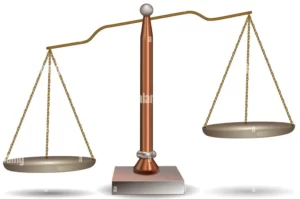
A simple beam balance is a basic tool used to measure mass. It consists of a horizontal beam that is supported at its center.
On either end of the beam, there are pans where objects of unknown mass can be placed.
The principle behind a beam balance is that it compares the masses of two objects. When the beam is in balance, it means that the masses on either side are equal.
Here’s a simple step-by-step guide on how to use a beam balance:
- Setup: Place the beam balance on a stable surface.
- Zeroing: Before use, make sure the balance is zeroed. This means that the beam is horizontal and the pointer is at the zero mark.
- Placing Objects: Put the object of known mass on one side (usually the left), and the object of unknown mass on the other side (usually the right).
- Balancing: Adjust the position of the masses until the beam is horizontal and in balance. The pointer should be at the zero mark.
- Reading Mass: The mass of the unknown object is equal to the mass of the known object. You can then read the mass from the known mass scale.
Concept of Beam Balance
The concept behind a beam balance is based on the principle of moments or torques. The torque exerted by the masses on either side of the balance must be equal for the beam to remain in a horizontal position.
Mathematically, this can be expressed as:
Torqueleft = Torqueright
Where Torque = Force × Distance from the fulcrum
That’s all we’ll cover in this tutorial. Now attempt the questions below to test your level of understanding of Mass.
THINK & ACT : If we can give you this for FREE, imagine what we can give if you pay and join the ALLSCHOOL JAMB Online Lesson. In the lesson, our hardworking tutors ensure they only teach you things that will come out in JAMB, so you’ll score extremely high in JAMB. Click Here to join the ALLSCHOOL JAMB Online Lesson NOW.
Practice Questions
1. What is the SI unit of mass, and how does it relate to the gram and kilogram?
a. Gram (g)
b. Kilometer (km)
c. Kilogram (kg)
d. Centimeter (cm)
2. In a beam balance, why does the beam tilt when objects of different masses are placed on its pans?
a. Because the objects have different shapes
b. Because the objects have different colors
c. Because the objects exert different forces
d. Because the objects have different masses
3. What should you do to zero a simple beam balance before measuring the mass of an object?
a. Adjust the position of the masses
b. Adjust the position of the fulcrum
c. Ensure the beam is horizontal with the pointer at zero
d. Add extra weight to one of the pans
4. If you place a 500g mass on the left pan of a beam balance and an unknown mass on the right pan, and the beam is in balance, what is the mass of the unknown object?
a. 500g
b. 1000g
c. Less than 500g
d. More than 500g
5. Convert 2.5 kg to grams.
a. 25 g
b. 250 g
c. 2500 g
d. 0.25 g
Answers and Explanations
1. c. Kilogram (kg)
Explanation: The SI unit of mass is the kilogram (kg). The relationship between the gram and kilogram is 1kg = 1000g.
2. d. Because the objects have different masses
Explanation: The beam balance compares masses. When objects of different masses are placed on its pans, the torque (twisting force) on each side becomes unequal, causing the beam to tilt until balance is achieved.
3. c. Ensure the beam is horizontal with the pointer at zero
Explanation: Before using a beam balance, it’s important to make sure the beam is horizontal (level) with the pointer at zero to establish a reference point for accurate mass measurement.
4. a. 500g
Explanation: In a balanced beam, the masses on either side are equal. If the known mass on the left pan is 500g, then the unknown mass on the right pan must also be 500g for the beam to remain balanced.
5. c. 2500g
Explanation: To convert from kilograms to grams, you multiply by 1000. So, 2.5kg × 1000 = 2500g.
Download this Physics Tutorial for Free
Recommended Articles for JAMBites
- Practice Real JAMB Past Questions with ALLSCHOOL JAMB CBT App
- Install LitTexts App: 2026 Literature Prose, Drama, & Poetry at your fingertips.
- How to Score Extremely High In JAMB [7 Trusted Tips]
- JAMB Free Tutorials [Free]
- All JAMB News and Updates
- Download JAMB Novel – The Lekki Headmaster [Free PDF]
- Likely Questions And Answers From The Life Changer
- When is the JAMB Exam Starting?
- JAMB Runs is FAKE
- Idioms You Might See in Your English JAMB Questions [Hurry, Check Them Out!]
- JAMB Syllabus for All Subjects [Official & Updated]
- Updated Accredited JAMB CBT Centers in Nigeria.
- How to Register for JAMB In Just 3 Steps [Everything you need to know]
- How Much Is JAMB Form 2025
- Solutions to Profile Code Issues [Get Yours Fixed Instantly]
- How to Fill JAMB Form the Right Way [Avoid Silly Mistakes]
- JAMB Brochure: JAMB Subject Combination for all Courses
ALLSCHOOL TEAM
Stories You Shouldn't Have Missed:
- Brilliant Nigerian Lady Bags Both Masters and PhD From US Varsity With 100% Grade
- 44-Year-Old Nigerian Artist, Banky W, Earns Master’s Degree from Georgetown University
- 11-Year-Old Girl Graduates from US University, Sets Record as School’s Youngest Graduate
- Stunning Nigerian Lady Bags 9 Awards after Graduating with a 1st Class, Shares Adorable Photos
- Grass to Grace: Village Boy Becomes Chartered Accountant, Inspires Many with His Short Story
- ‘Aboki’ Uses Engineering Graduate’s Certificate to Sell Suya, University Reacts
- Most Respected Sec Schools in UK to Storm Nigeria in Search of Qualified Interested Students
Join Our 500,000+ Community:
Thank you so much for reading. We will appreciate it if you share this with your loved ones.